Reach Old Lady – Reach

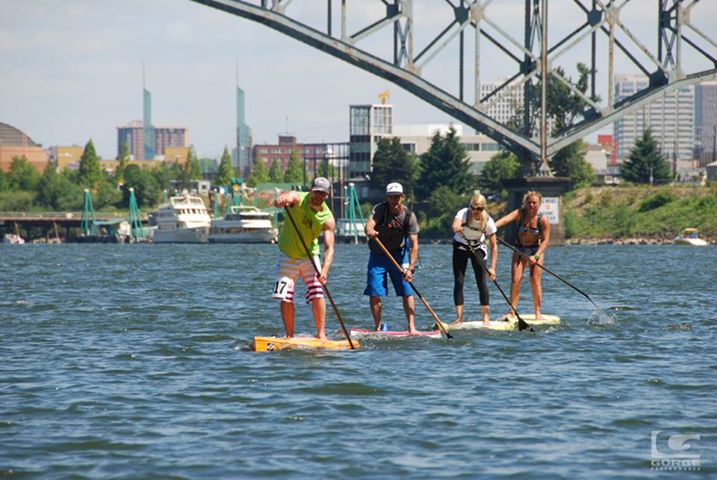
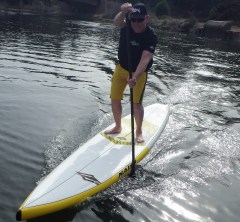
I am working to prepare myself for the challenges of doing both days of the Naish Gorge Paddle Challenge and then a month later the course OPEN race at battle of the Paddle. I am glad there’s a “sweet old lady” class for us 60+ year old chicks,  And also thrilled that there are enough of us to make a fine class – how cool!odell-me-kerui

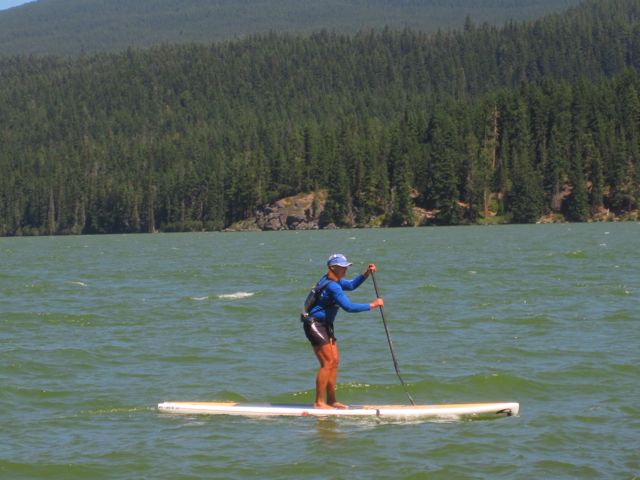
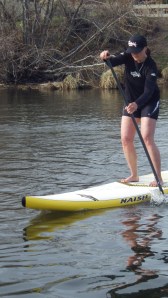
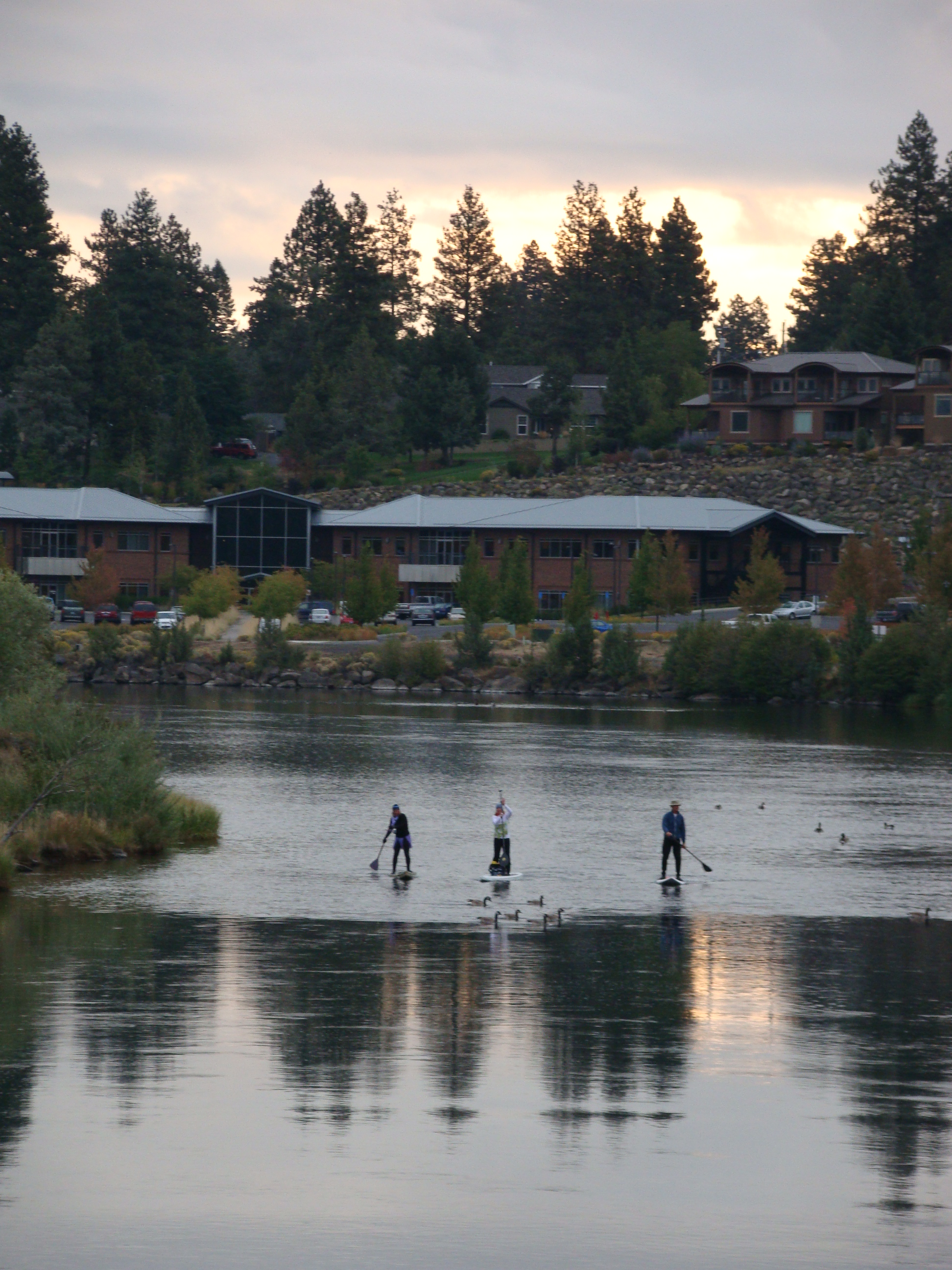
IMGP0110The preparation and training has been so much fun. I have the joy of living along the Deschutes River. I can do up/down stream training runs right in the middle of Bend Oregon. I can drive a bit out of town and do 4-5 miles upstream and 4-5 miles back downstream to my car. The span can include the upstream ripples of Dillon Falls all the way to the forceful end of Benham Falls. The scenery is beyond beautiful.

My heart rate monitor keeps me in my selected training zone when I get distracted and sprint too often and for too long. Building a nice cardio base is pretty darn important when you are ready to be a full – fledged Medicare card carrying member (insert LOL here so as not to freak out).

I have been practicing on being efficient. Getting the most power and momentum per effort-unit is imperative. I have watched this video and have read this training tip by dave Kalama so many times – it’s been terrific. Thanks, Dave!

When I complete these events with a smile, I will thank you even more.

SUP: 53 Degrees in the Summer

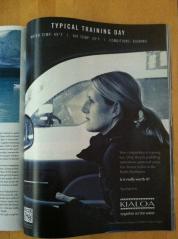
This KIALOA Paddles ad with Karen Wrenn inspired my that 56 degree morning in July

This KIALOA Paddles ad with Karen Wrenn inspired my that 56 degree morning in July

Flip through any of the many (thank goodness) SUP, paddling and surfing magazines and you’ll be dazzled by photos of surf, sun, bikinis, waves and warm water.  One ad catches me every time because it’s the polar (sometimes literally) opposite. It’s KIALOA Paddle’s ad showing Karen Wrenn psyching herself up for a training paddle in cold, wet, blustery weather that is so common in the Pacific Northwest. Do you know that kind of weather?

In preparation for the Naish Gorge Paddle Challenge in a few short weeks, my plan is to add to my weekly mileage. Between work and other obligations, early morning is the best time to grab the hours needed to bag 5-8 miles up and down current in the Deschutes River. Ahhh, summer. 85-95 degree days have warmed both water and air making paddling a pure joy. Except for last Wednesday.

I was fooled by the blue sky and sunshine as I loaded my board. For some reason a northerly wind had funneled in along with lower temperatures. I got to the river still warm and cozy in my car. The first alarm bell rang when i saw the flags rippling straight out as the wind blew in the face in the UPSTREAM direction. That is never good. I stepped out of the car to unload my board and stepped into – COLD! Seriously?
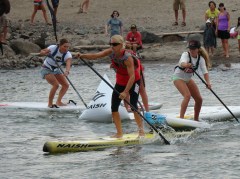
Getting tuned up and ready for my first Gorge Paddle Challenge course race - inspired by KIALOA 'Eleles Karen Wrenn and Brit Oliphant

Getting tuned up and ready for my first Gorge Paddle Challenge course race – inspired by KIALOA ‘Eleles Karen Wrenn and Brit Oliphant

I had neglected to do a temperature check back at the house. What was it? I turned on my car only to discover the outside temperature reading was 53! How did I miss that? Now, it’s true that in the winter, a sunny 53 degree day no matter what the wind chill is will seem like a “warm” day.  In the winter we are prepared for chill – booties, fleece and the right mind-set.
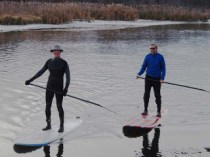
WE bundle up for cold paddles in the winter!

WE bundle up for cold paddles in the winter!

On the late July day, back in the car I sat huddled. I wanted warm, tropical breezy warm! It was time to channel my “inner Karen Wrenn” – please!  I managed to talk myself into getting onto the river and completing the planned distance.

Weirdly, after the first mile (brrrrr) I got sweaty, steady and in synch with wind, water, paddle technique and the beautiful morning.

Today, a mere 5 days after that challenging mental discipline of chilly last week I set off to 6 am yoga (wonderful) and went straight to the river for another 5 mile training paddle.

It was 55 today, wind brisk  in the face up current again. I hesitated, but just for a moment. I had the image of last week’s paddle set in mind.  It wasn’t raining, it wasn’t snowing and the river was almost empty.  If we want to have the best experience at the many SUP events available in almost every home town we need to prepare.  Sometimes we need not to over-think how it’s gonna be and just let our training session BE. Again today, it was delicious!

Sometimes WIND IS YOUR FRIEND – read more here
SUP Play: Turns and Practice

A few decades ago a friend of mine raced Ferraris – as a hobby. He trained hard and practiced often. Somehow the strategy for making an “S” turn came up and he explained, “The fastest way through an ‘S’ turn is a straight line.” So often in sport, the most effective approach isn’t always easy to execute. I filed that away until recently as I tried to negotiate a few buoy turns in a local race. The leaders made a turn shaped like a sharp “V” – At buoy, quick tail turn, then past buoy. Just like that!  The slower buoy turns, like mine, looked more like a huge looping arch – widely past the mark and inefficient. T needed a new strategy and technique.

A few weeks ago I saw a clip of a TV show Candice Appleby taped just after her prone division win at the 2013 Surftech Jay Race. Candice took Ali Fedotowsky of 1stLookTV (New York) out for a SUP lesson – and tons of fun. They were joined by Chris Aquilar (cinematographer) – Video link

At just about the 3-minute mark in the video, Candice easily and gracefully performs a tail turn. Out of the entire TV clip that scene stuck with me for weeks.  In between, we had a few races around the area. It was obvious that the paddlers who had perfected their tail turn – with accompanying paddle technique, foot-work and balance – made up time at every buoy turn.  We all work hard to perform at our best in events – maybe we should take a page out of Candice Appleby’s book – her “play book.”

Photo by Gail DeSoto DeMarco

Photo by Gail DeSoto DeMarco

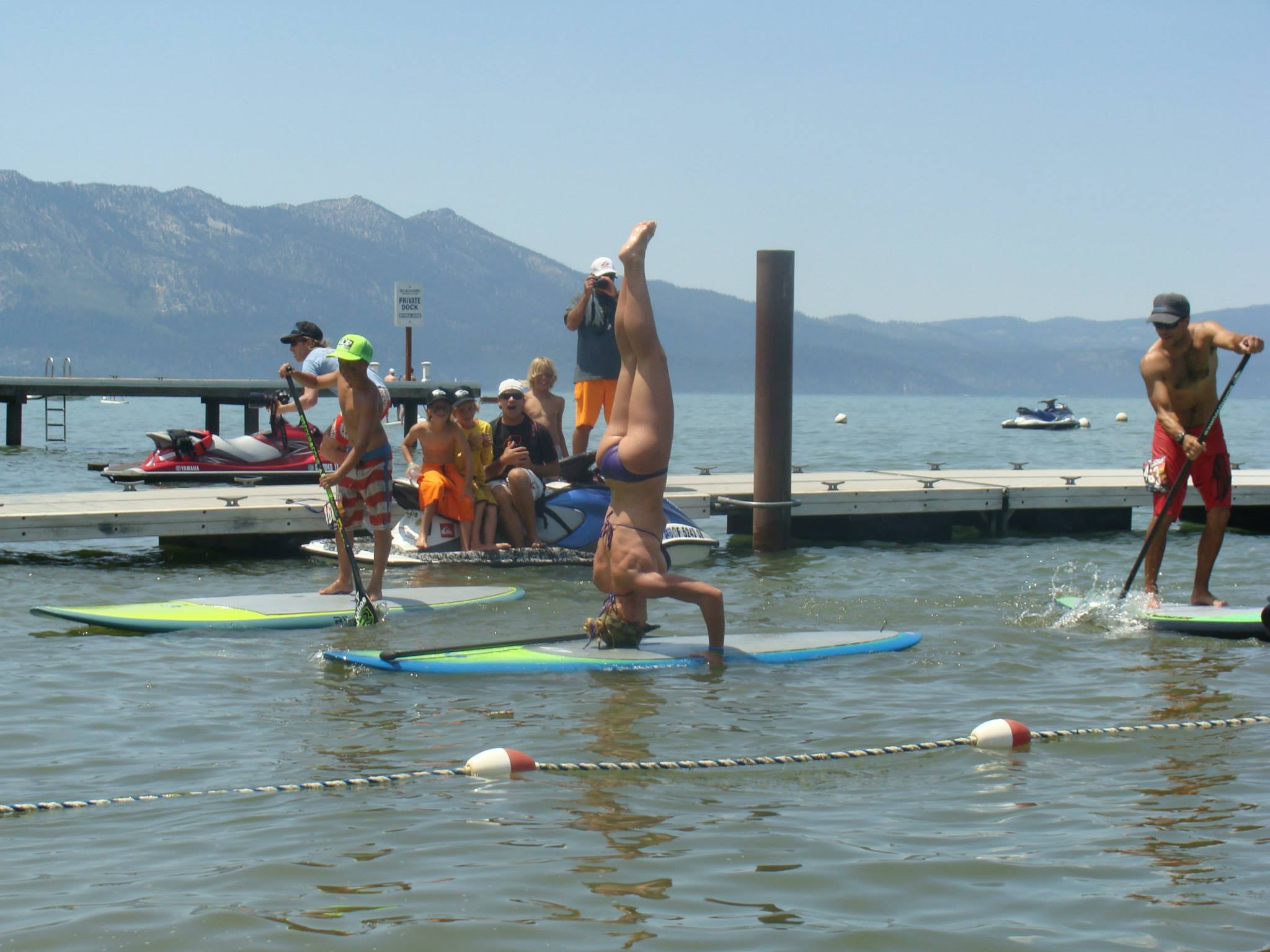
I have never seen someone do so much hard work and practice all with an amazing sense of joy and play.  This is just one example of fun times at Race the Lake of the Sky during the “Sweet Moves” contest presented by Sweet Waterwear. Credit to Gail DeSoto DeMarco for capturing the photo.

A few other photos shared by Candice on her Facebook page continued to inspire me to take some risks, take some time and go play at tail turn practice.

candice tailturn1  candice-headstand-wild

The headstand – I am still just 20% of the way on that one. But on a warm sunny day last week the tail turn played along with me and I began to get the groove.  Practice – I did a few dozen but it’s obvious that hundreds will be executed before I have a bullet-proof turn. Can’t wait to get on the river this week and hunt down something to turn around – a buoy, a rock, another paddler – whatever can make it a game! Thanks for the inspiration and sense of absolute play, Candice!

Summer Sun: SUP Performance Wear

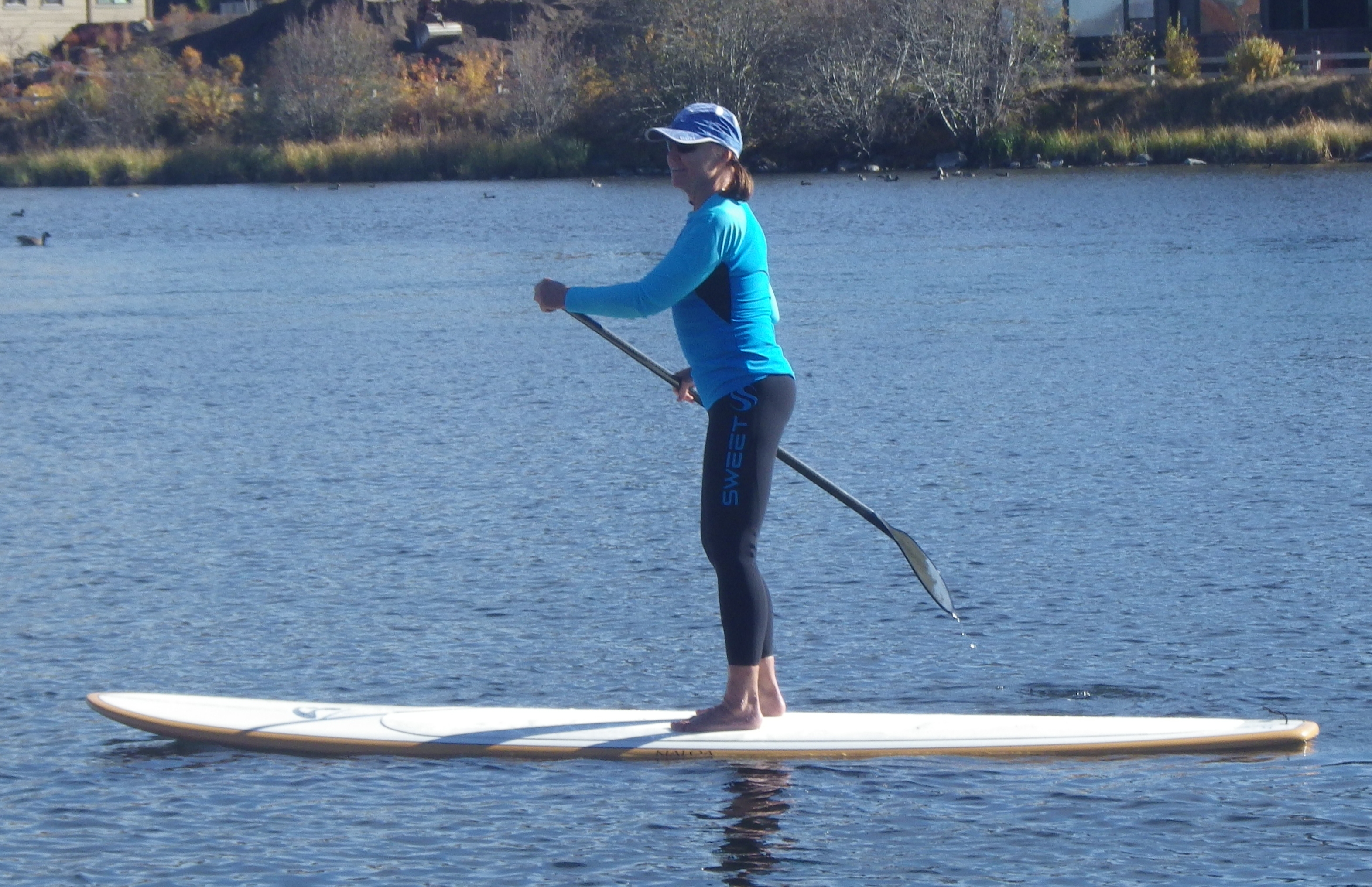
Midway through a 12 mile paddle in my Sweet Waterwear paddling top and compression pants

January warm in my Sweet Waterwear paddling top and compression pants

As temperatures rise we slap on the sunscreen and savor summer SUP fun.  As the paddles get longer, as your skills drive the quest for more adventures, more exploring, more down-wind wildness there’s another key item to consider – performance paddling gear. It’s not just a cozy layer to keep the chill off – the right gear makes all the difference as we push our endurance, challenge our muscles and work our joints.

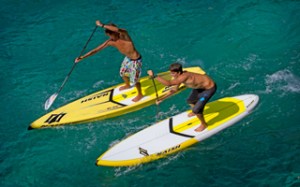
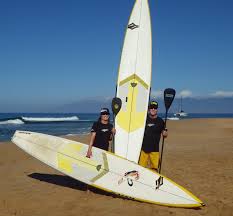
The first thing we did was to check out the Naish 14′ Glides we’d be using all weekend.  Steve Gates and Jason at Big Winds took great care of us.  Hood River (Oregon) looks like Naish Central whether it’s SUP, windsurfing or kite-boarding. naish2naish-flga

We enjoyed a clinic by Jeremy Riggs of Maui as part of the fun provided by Big Winds in Hood River, Oregon. On Saturday the wind was a rare serene breeze allowing us to do a glassy down current run from Mosier back to the Hood River event center. Sunday roared in with steady 25 mph winds cranking up the Columbia River Gorge spiced with gusts of 30 mph or more.  The river provided sweet glides, a good bit of chaos with side chop and sets that encouraged us to try connecting glides and soaring.  It was epic for all 25 of us!

Candice Appleby shows us how it's done!

Candice Appleby shows us how it’s done!

Hauling my drippy self onto my board again and again was an effort. Instead of being chilly, as the wind quickly dried my Sweet Waterwear performance top I warmed up easily.  After the race while we chatted and enjoyed a local “cold beverage” my legs felt hugged and cared for in my Pro Elite Performance Tights.

We love to look toward our favorite elite water athletes for tips on gear and training – it just makes good sense to notice what they’re wearing for enhanced performance.  In the video below the silver arms of my performance top is just the half of the cool fuschia I love!

Saturday: Glassy Goodness ( see video here)

Sunday: Epic Columbia River Downwind

SUP Endurance: Karen Wrenn Rocks

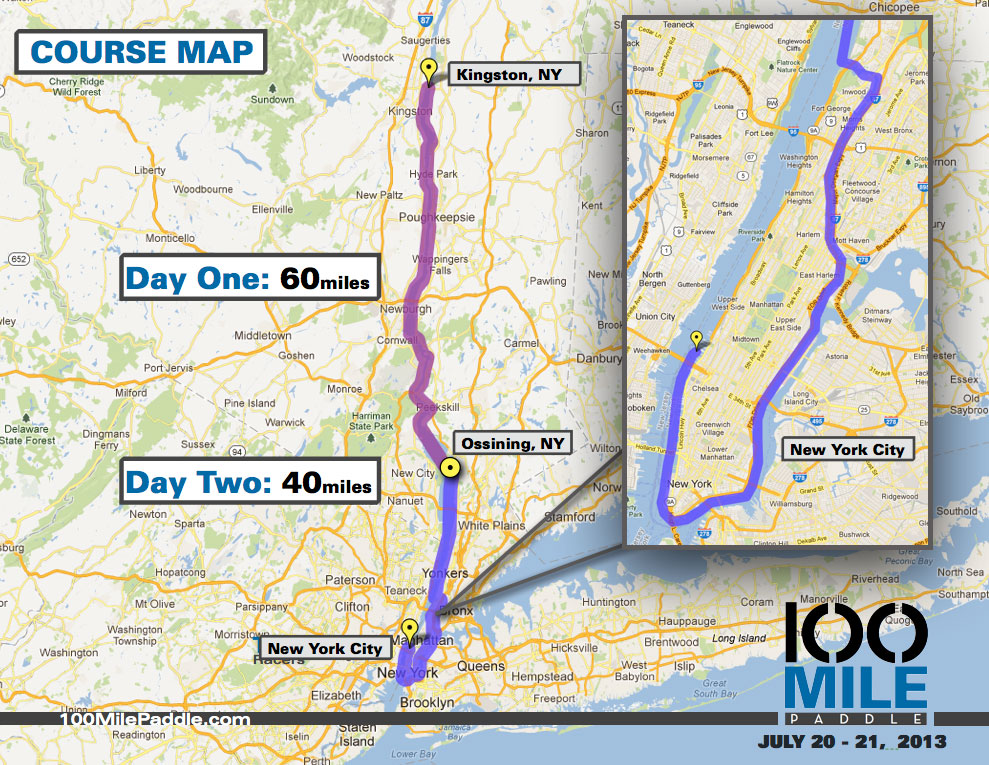
In a few short weeks SUP endurance athletes will gather for a cause at the 100 Mile Paddle, the ultimate adventure paddle & race for teams and elite paddlers.

100mile3This two day adventure paddle will start 75 miles north of NYC and follow the Hudson River to a breathtaking loop around Manhattan. It’s not surprising that KIALOA Paddles team rider, Karen Wrenn will be there paddling strong and raising funds for causes she cares about. The goal of the event is to raise awareness and funding for Autism Charities and Clean Water Initiatives.

As cool as the event sounds, it is not for the un-prepared.  Training for an endurance event of this sort is almost as grueling as training to, let’s see, climb Mt Everest.  The point is that the athletes able to solo a 100-mile paddle have demonstrated discipline, commitment and focus in their training.  So, what about us mere mortals who might want to do a crossing, paddle 30-40 miles or simply prep for race season?

Karen Wrenn training with friends

Karen Wrenn training with friends

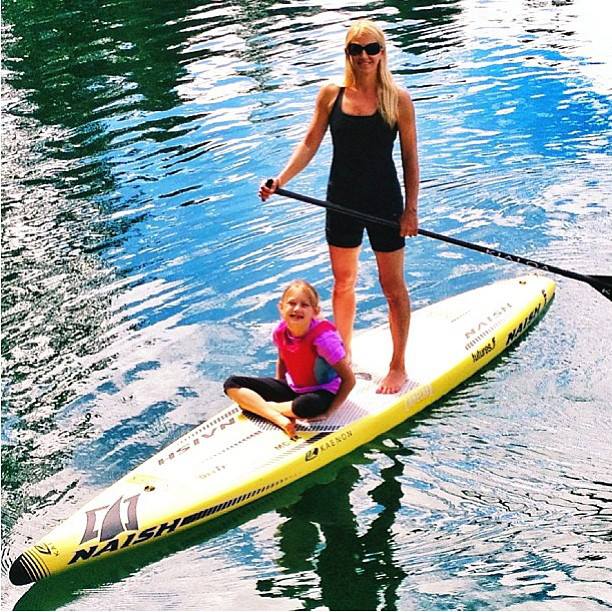
If you take a page out of Karen’s book you’ll add a key ingredient – have fun training.  If you follow Karen’s blog or LIKE her on Facebook you’ll discover how she keeps the stoke going.  You’ll see her on one of her quiver of NAISH SUP boards almost every day.  All work and no play is definitely not her style. A busy mom, Karen adds family fun to time on the water for a terrific win-win experience. wrenn-100

Whether on the flatwaters of an Oregon lake, the often gnarly surf on the Pacific coast or fighting upstream currents (and dodging freighters) on the Columbia River, Karen is putting her time in to prepare well for the 100 Mile Paddle.

Another NAISH SUP team rider, Suzie Cooney, CPT, has shared some endurance training ideas that any of us can use.  She is excellent at breaking down each aspect of strength and endurance required for your best SUP experience. According to Suzie, “You already know that balance is a huge part of being a good paddler but so is leg strength.  It’s much easier to train the larger muscle groups such as the glutes, quads, hamstrings and calve muscles, but what about the tine supportive muscles around the ankle joint, knees and hips?  They are often under trained and overlooked.”

I couldn’t agree more. I read Suzie’s article and have added her suggestions to my weekly training routine – with surprising results. I look forward to hearing your comments.

wrenn-naishboard1Maybe we won’t charge the Maliko run like Suzie Cooney or raise funds for great causes via a 100 mile endurance race like Karen Wrenn – but we can grab our best endurance ability with gusto – and a grin!

You can follow Karen Wrenn on Twitter.

SUP Training: Observations

Waking up to a big dawn, orange full moon in my face and a sudden “ouch” at the first moves of the day.  Upper back, ribs, and upper abs screamed resistance at my walk to the kitchen for morning coffee. And guess what – I am one HAPPY person.

Karen Wrenn SlideAfter getting more knee and low back fatigue during longer and stronger paddles over the years I reached out for some advice on technique. Fortunately, Karen Wrenn (super inspiring) shared some insights (you can follow her on Twitter) and with some practice I am creating a more effective technique.  I found this artistically beautiful video on the HangerFox Youtube channel that allows us to observe the technique that creates that highly effective paddle stroke that serves Karen so well.

With Vimeo, YouTube, blogs by pros and all sorts of social media links, we can “meet up” with SUP professionals we admire. SKYPE is another way we can get great training tips from our favorite pros. Suzie Cooney, CPT of SuzieTrainsMaui encourages SKYPE training and has had great success with that medium.

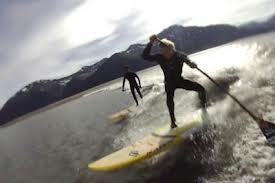
Robby Naish (happy birthday this week) and Kai Lenny in Alaska

Robby Naish (happy birthday this week) and Kai Lenny in Alaska

Recently I watched a short video of Kai Lenny and Robby Naish paddling around icebergs and basically “chilling” in Alaska. It’s good to study their stance, paddle placement, reach, posture and recovery during racing sequences as well as more recreational paddling.  Sometimes it’s tough to assimilate exactly what is making their performance so efficient and powerful.

dave-safebackThis very short video by Dave Kalama posted on the Distressed Mullet YouTube channel gives direct and easy to implement advice on how to protect your lower back. Hinging rather than bending is a habit that is not too difficult to hone – give the video a few, or maybe a couple of views then try the movement on your next paddle.

Dave Kalama provides a more advice in his blog article I found to be easy to put into practice. “Don’t rush.”

He explains that even if your technique is effective, it doesn’t necessarily mean that you are utilizing it properly. If you rush through all the phases of your stroke and don’t take the time to execute each phase correctly, then you are not using your level of technique in an efficient way.

For me, one of the pieces I took away was to take the time to really drive the paddle down into the water. Create a complete stretch of your reach. According to Dave, ” it only costs you a little patience and time to completely extend your arm forward. Also, rushing through the recovery phase will break the flow of a smooth rhythm, which is where real efficiency resides. If you rush into getting your hips all the way back under you to the neutral position, then you miss out on all the potential momentum you can generate through the hips. dave-technique

During yesterday’s training that resulted in muscle fatigue and “good workout” soreness, it might have been that fully extended reach, getting my hips back to neutral and rotating the upper body appropriately that made all the difference.  There’s nothing like practice, exploration and observation to add even more fun to this sport we love so much!

We’d love to hear from you – what blogs, videos or images have been useful as you improve your technique?


SUP Addiction: The Glide

Innocently, you join friends and fellow competitors for your first down wind SUP adventure. River, lake or open ocean – when the wind and the bumps cooperate the experience is incredible.

There’s so much to think about – paddle stroke, wind and wave direction, safety around rocks, channels, tankers or current and your own stamina and ability.  Whether your first run was 3 miles and easy or a kick-your-butt challenge, it’s likely you emerged from the adventure a different person.  Perhaps, like so many of us, all you can think about is doing it AGAIN! Yup, you’re hooked.

In between opportunities to do down winders, SUP Magazine has an online series that can provide tips and insights any time.  Take a look at the Glide Guide.

Some take-away tips from the video (see below) of Jeremy Riggs training Justin Gordon include:

The key thing keeping up your momentum.  Shorter rapid paddle strokes keep momentum going – keep speed up

Don’t go right up the back of the wave in front of you – that will slow you down and you paddle UP.

Look for the place to keep the momentum going, a place to guide the board into the trough where you can catch the next bump – and have tons more FUN!

Aloha of the Paddle

Our SUP paddle – connecting us to our water, our power, our speed and the aloha of our our sport. Choose wisely and understand small tweaks in sizing and technique that make all the difference.  Part of the “aloha of the paddle” is the great community of people willing to share info and insights about all aspects that impact both performance and enjoyment!

A conversation with Randall Barna, SUP pioneer and owner of FootForm Performance Orthotics Center in Bend Oregon, always leads to great technique insights. During a recent paddle I was absently day-dreaming about my soon-to-be delivered Hulu KIALOA paddle while listening to the steady rippling of wind current under my board.  I wasn’t really thinking of my technique, just sensing the paddle position through the reach and recovery and watching out for river otters. Randall commented, “You might want to try something a little differently as you switch your paddle from side to side.”

I am always up for more power or speed, especially if it’s driven by efficiency. Randall showed me a seamless way to switch my paddle from side to side. Removing the upper hand as the lower hand remains steady on the paddle during the crossover (maybe inching it up the shaft an inch or so) allows the “new” bottom hand to grab at just the right spot allowing an immediate “reach and dig” as the new upper hand slides up to the grip. It was a simple change but really added a solid confidence to switching paddle sides.

Board speed and chop, two foot placement variables

Board speed and chop, two foot placement variables

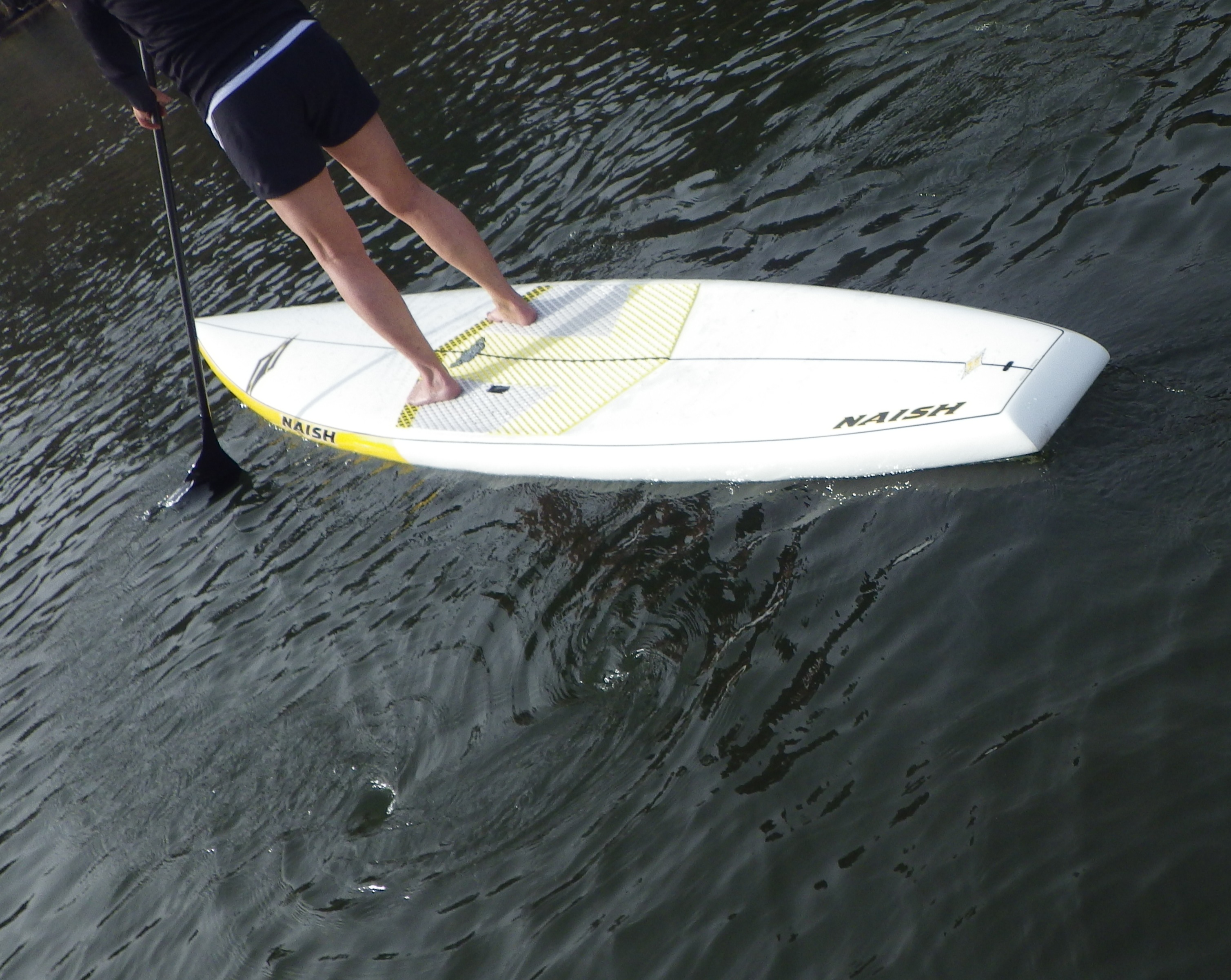
As long as Randall was sharing insights gained by a lifetime of wind and water sports I invited him to share tips on foot placement. “The key to foot placement is adapting and adjusting to all the variables. As soon as you think you’ve nailed your stance something changes! The two main variables are board speed and chop. The two errors are tail drag and pushing the nose.

You’re too far back on the board and tail drag is a drag. It slows you down more than anything else! Too far forward and you’re pushing water instead of gliding. The key is a balance between the two.”
Variables in board speed require you to make constant, minor adjustments. Take some pictures of yourself on your board while pictures standing still. Is  the tail is out of the water? With a little speed the tail is right on the surface. That’s because under power the board starts sinking into the trough of it’s own bow wave. naishbow
Randall continued, “Progressing into higher speeds the bow wave gets bigger, the board lower, and eventually it hits “hull speed,” a point where it won’t go any faster no matter how hard you paddle.  Every board responds to this differently and is dependent on the weight of the paddler too. You just have to experiment with foot placement at hull speed, find your sweet spot, and mark your toe line on your board as an instant reference.”
Note: huge grin on Randall’s face as he shares this: “The big thrill in riding an SUP is planing! To achieve planing you have to get your bow through your bow wave, up and over it! Nobody has ever accomplished this by paddling. Longer boards are faster due to a longer interval between the bow wave and tail wave,but still no planing via paddle.  It takes a boost from an outside source like wind and waves. As soon a the boards cuts-loose onto a plane you have to adjust your foot position faster than poop-thorough-a-goose. The nose will dive, the tail was lifted by the wave, so step back. You need to constantly walk the board and paddle to keep it on a plane, and enjoy the ride.”
Champing at the bit to get on  Naish 14' Glides on Maui

Champing at the bit to get on Naish 14′ Glides on Maui

Experimenting on flat water is not easily transferred to choppy waters. The nose of the board becomes the focus.  If your nose is pushing, it will slap each chop and be very slow. Find a foot position where the nose will penetrate the chop without slapping or pushing. Side chop, and accompanying wind, can catch your nose and flip you over! Try a surfer-stance for more stability, with the wind at your back. You won’t be switching sides with side-winds anyway so this works. Another source of choppy water is when drafting another SUP. Then you’re dealing with their tail wake, your bow wake, and the chop all at once! All of this is a never ending challenge and one of the things that makes standup paddling so darn much fun!

SUP: Da Feet

That moment after a too-steep take-off when the nose of your surfboard buries deep, that moment just before you rocket through the air tightly clutching your paddle – you know! You know that your feet were not in the ideal position to trim your board successfully – it’s obvious.

Karen Wrenn posted this very cool photo - great color and an easy way to study foot position and technique.

Karen Wrenn posted this very cool photo – great color and an easy way to study foot position and technique.

More subtle are the changes in board trim and efficiency or glide that occur with where your feet are place and the balance of weight on those two feet when going in flat-water or downwind. A good example is the way Karen Wrenn is positioned in the photo to the left. She was kind enough to explain, “If you notice how my feet are really far on the left side of the board… it’s because there was a super strong side wind coming over my left shoulder. I had to position myself on the far left of the board to keep from getting pushed by the wind to the left. With my body weight on the left side of the board it allowed me to get my left rail down and prevent getting pushed and tipped.”

Knowing the force of winds in the gnarly Columbia Gorge area where Karen spends a great deal of training time, that is good to know. As the weather warms, our local SUP community plan many jaunts to the Hood River and Portland area for down wind fun.

With just a few weeks before the most challenging down wind adventure of our lives at Maliko Gulch and the Olukai Ho’olaule’a, we have been barefooting it on the sleek 14′ Naish Glide as winter hiccups into spring.  Balance as we maneuver is crucial – falling into the barely above freezing Deschutes River is not an option.

There’s the rub! Tail turn practice goes tentative – and immediately balance becomes sketchy.  It’s a great mental practice to feel the right movement to position and coordinate strong paddle strokes.

Evening light adding to our bliss!

Evening light adding to our bliss!

Our puzzle remains – what’s the best foot position for the various aspects of conditions we’ll encounter on the Maliko down wind route?  We will be sharing this post far and near, hoping for insights and input. While we will be participating in a “race,” our goal is safe completion of the journey.

Wondering how this foot position is for strong "wind in the face" situations

Wondering how this foot position is for strong “wind in the face” situations

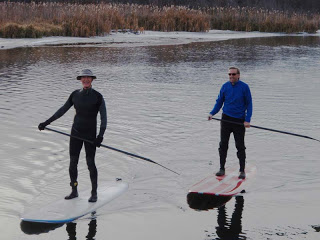
Ed is experimenting with feet further back, noticing the impact of the tail drag vs speed and efficiency

Ed is experimenting with feet further back, noticing the impact of the tail drag vs speed and efficiency

We know we have awesome equipment with our Naish 14′ Glides underfoot, so we hope to refine our skills so that we can make the best of the famed “glides” we’ll be earning along the way.  How incredibly cool is it going to be to feel that first rush of wind after going beyond the cliff at Maliko Gulch! What a thrill it’s going to be to be surrounded by hundreds of other paddlers as the swells start rising on our quarter and from directly behind!

Butterflies – yup! We can’t wait to practice in the warm ocean – to fall as often as needed into WARM water – and to peddle forwards and back along the foot-friendly deck of the Naish Glide.  The best and right equipment for the adventure adds so much confidence and fun to the mix! Yeah, the stoke is fueled.

Please share your insights and comments on the blog or via e-mail eldersup@gmail.com – some comments we have received so far can be read at Aloha of the Paddle.

This seems to be a good foot position for flat water up wind and down - comments?

This seems to be a good foot position for flat water up wind and down – comments?

SUP Senses: Listening

Taking a spin around the perimeter of a glassy lake at sunset, traveling upstream in a class I whitewater stretch or gliding shore-ward on a gently breaking wave or sense are alive.  We experience sights, smells, the feel of water on our bare feet and the sound of water. We hear the swoosh of a glassy glide and the slap slap slap of small ripples playing off the hull.

Sometimes when I am training for a steady pace over a longer time or distance, I set the “metronome” to the sound of the slap-slap-slap of water on the board. 1-2-3 and then 1-2-3, switch sides and, 1-2-3 then 1-2-3 in a steady pace. It gets easier to maintain a pace with a steady beat going in my head.

Then comes a real eye-opener. I had a GoPro facing forward on the bow and then facing back at me during a recent glassy paddle as dusk approached last week. (video here) My 1-2-3 was way more slow in pace than I had felt while actually executing the pace.  I needed to add some intervals – and soon! With just 51 days until the first downwind event of the season I want to be totally confident and ready to go my race and my skill level- but do it well.

karmathonevent030Last Sunday I had the chance to paddle a sweet, but frosty 42 degree, 6-miler through two loops in the Deschutes River as it winds through Bend, OR.  I went with a local SUP surfer and racer, Randall Barna. Randall watched my paddle stroke and tweaked my reach and return a bit. We discussed how much Karen Wrenn’s suggestion to keep my knees and hips facing forward even as the upper torso/ribs twist. Randall had a cool way of creating the image I needed to drive forward and be more efficient with my technique.

I tend to fall backward when tossed off balance, so Randall explained the reasons to stay fully balanced on all 4 corners of both feet. Rather than driving the board hard and down – then forward, the better image is “create a buoyant feel as you press the board forward with the sense of floating it lightly but firmly.” Thinking about these tweaks allowed miles to float by easily.

I still need to build a better fitness base for the upcoming paddle season. According to Suzie Cooney, CPT (of Suzie Trains Maui, a Naish team rider), “Music added to your own SUP training session can make a huge difference in you enjoying your training session and can actually help you increase your mileage and decrease your time. Get to know your heart and lung capacity and stress yourself accordingly. Make sure you are in good physical health and have proper clearance from your physician.” Great advice.  I read her excellent article on training with a balanced tempo playlist, donned my heart rate monitor and had some great paddles so far this week. You can do the same. Take the few short minutes needed to explore Suzie’s online training article – then go enjoy standup paddling with all your senses!