Unknown's avatar

About Water Words

https://elder-sup.com/about-2/

Bouncy Pink: Cyril Burguiere Talks Story

When I invited one of my favorite Pacific Northwest SUP competitors to answer a few questions about SUP and his life, I expected a short response mostly focused on his very cool training routine. Instead, Cyril responded with a treasure of a story.  It’s a fascinating read filled with insights and suggestions easily woven into a family’s experience. Please enjoy every word – all the way to the powerful final lines. cyrilpnk1
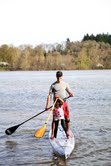
Cyril Burguiere "sees pink" across a handful of sports enjoyed with the whole family

Cyril Burguiere “sees pink” across a handful of sports enjoyed with the whole family

Family is my priority, my love, and my passion; however, sports and the outdoors are right up there as well playing a big role in every decision, every dream and aspiration. The great thing is I don’t have to sacrifice one for the other. They can all be combined together – they are all part of a lifestyle, and the more I explore this lifestyle, the further I get pulled into it. I credit the Northwest and watersports communities for helping us see the way along this journey.

My wife and I standup paddle (SUP) and ski, so our kids do it as well. We don’t watch any cable television, so our kids don’t either. We realize that our children will get more and more influenced by mainstream culture, but we believe they will naturally gravitate to this lifestyle because it is so good.
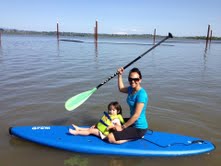
Cyril and his wife, Tiffany, share the family-sports stoke!

Cyril and his wife, Tiffany,  share the family-sports stoke!

I always played sports as a child, but nothing close to what my children are getting. I did get to explore the world, its cultures and landscapes and always had a love for travel and the outdoors. It wasn’t until my early teen years that I started my near obsessive relationship with sports, but they were all indoors or on artificial fields. I competed in NCAA Div I track and field and learned a lot about training discipline and the importance of technique and repetition. I even wrote an essay about the benefits of sports for children (my now wife was a classmate of mine). In my 20s, I finally started experiencing outdoor sports. I also became a proud father of two girls, Erica and Isabel.
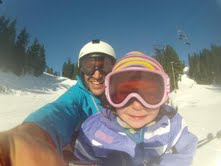
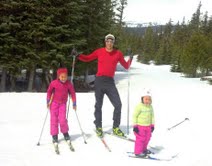
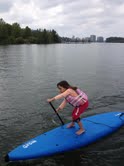
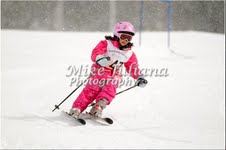
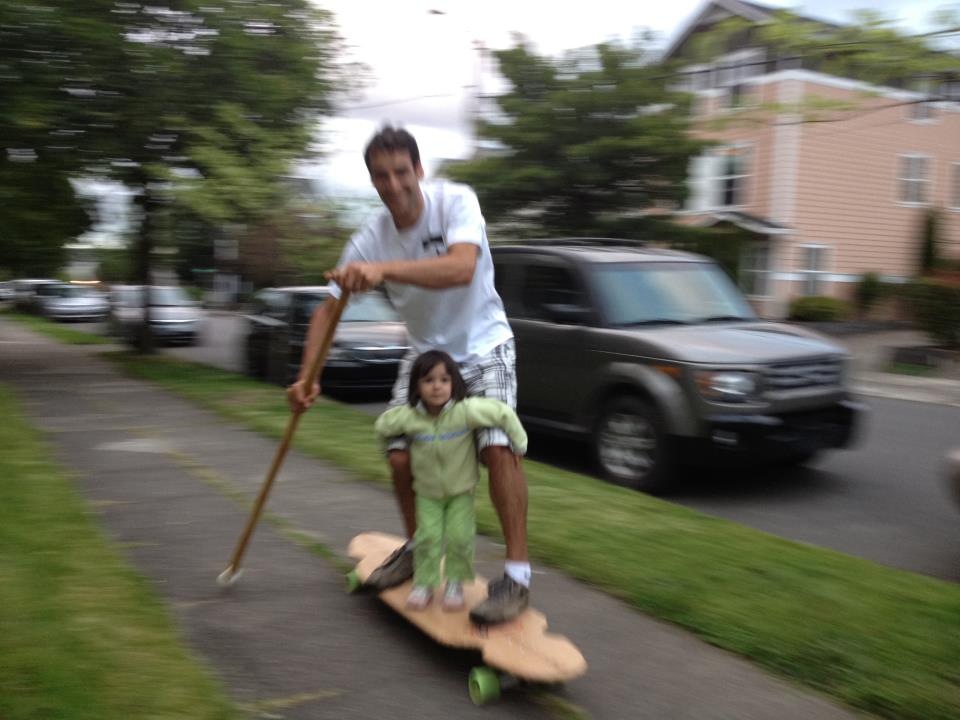
cyril9Now a father of two daughters, I have learned so much from them. I’ll be honest, when I first found out we were having a girl, we were living temporarily in Texas, and my then old-world (‘traditional’) way of thinking, had me thinking sports as a family were going to be lower priority, probably something I’d have to go and do alone. I was visualizing Barbie dolls and pink stuff everywhere. I was only partly right: the pink stuff became Erica’s ski jacket and goggles following behind me on steep ski runs and hucking off a 4ft jump when she was 3 feet tall, the pink KIALOA sticker on her Keiki paddle, and my daughters’ pink gymnastics leotards bouncing up and down almost daily on our backyard trampoline.
cyril4 cyril5 cyril6 cyril7

A pink blur = great fun

A pink blur = great fun

Some of the rules we live by:

  1. Fun. Keep it fun. This is not the time to get an adult workout in. Build a snowman, stop to check out the wildlife, enjoy the large tree roots and caves on the mile long trail down to the surf spot. Show your passion and fun – bring out that inner child that is so easy to do with sports. On our many trips to summer SUP races, we try to mix sightseeing to keep it fun for the kids. My fellow KIALOA paddles teammate, Karen, is really good at this as well – our families actually met up at a wildlife safari park on route to the same SUP race last year.
  2. Explore, diversify. As I mentioned, we are a ski and paddle family, but we also mix in other activities, such as gymnastics, swimming, slackline, trampoline, bike rides, playpark, beach. We learned from this after we put Erica in a full weekend, all winter, ski race program at 5 years old: she loved it and excelled at it, but she burned out and wanted to do other things. We’ve since dialed back and now try to diversify the activities more. For example, we will not do more than two days of the activity our children are requesting. Living in the Northwest makes diversity easy – I’m writing in the Spring, when we can literally do every sport mentioned above and there is a whole community behind each sport wanting us to be a part of it.
  3. Balance, agility, suppleness. I’ve read several studies that examine what is most important in a child’s development at different ages. For youth under 8 years old, these three skills seem to be the most important for development. Endurance and strength come in the later years. For this reason, our cross country ski loops and paddles are short. Most events we have been to organize short kids races, which is great. We spend more time jumping, turning and showing off. Gymnastics, the playpark, our basement trapeze and the trampoline have all been great for our girls – they gravitate to these sports on a daily basis to use up every bit of energy they have.
  4. Rainy days rock! As parents, we model that rainy days don’t stop the lifestyle. We’ll still walk to the supermarket, I still paddle and bike to work regardless, we never say “oh no, it’s raining!”. Actually, SUP in the rain is amazing when the water is calm – I love the way the rain drops hit the water, and I still paddle just as fast! Rain in the winter also means it is snowing in the mountains, which is great for our ski season. Our family is always watching weather and planning our next adventure and for that reason we get more sun than anybody else. I have many stories of friends complaining about a rainy weekend, when it was actually sunny an hour away at the coast or mountain.
  5.  TV is for family movies.
  6. Provide kid’s gear. It doesn’t have to be high end; it doesn’t need to be waxed. Our kids love knowing they have their own gear – whether it is a paddle to take dad’s board around, or some hand-me-down skis from big sister or friend. This can be the most challenging for finances, especially when trying to diversify and explore many activities. We found an incredible combo in our kids’ board, the Tahoe SUP Grom and paddle, the KIALOA Keiki adjustable paddle. Both pieces of gear should last them from age 2 to 12!
  7. Listen – and HEAR. It gets old hearing “great job!” and “you were awesome!”. Those are obviously very important, but having been on the receiving end as a young athlete, I know the importance of getting honest feedback and encouragement. I forever thankful to my mother for having always stopped to listen to me talk about my sport and what went right or wrong. We ry to let our kids communicate and think through what they have done, and I believe it does them a lot of good to discuss specific examples of what was a ‘great job’ and what was not so awesome.
  8. Healthy eating. Last, but definitely not least. This obviously starts with the parents and is truly a lifestyle. We don’t claim to be experts, but we enjoy learning and talking about food. We try to talk to our kids about the benefits of different foods and how to combine foods. Erica’s top 5 foods: 1. Red lentils, 2. Spaghetti, 3. Tomato soup, 4. Pizza, 5. Raw peppers.

cyrilpnk1There are many more things, such as sleep, that could make the list. The main one – have FUN! Get out there regardless of the weather – you might surprise yourself and your kids won’t even know the difference. To them, nothing beats being outside with mom and dad!
SUP Training: Observations

Waking up to a big dawn, orange full moon in my face and a sudden “ouch” at the first moves of the day.  Upper back, ribs, and upper abs screamed resistance at my walk to the kitchen for morning coffee. And guess what – I am one HAPPY person.

Karen Wrenn SlideAfter getting more knee and low back fatigue during longer and stronger paddles over the years I reached out for some advice on technique. Fortunately, Karen Wrenn (super inspiring) shared some insights (you can follow her on Twitter) and with some practice I am creating a more effective technique.  I found this artistically beautiful video on the HangerFox Youtube channel that allows us to observe the technique that creates that highly effective paddle stroke that serves Karen so well.

With Vimeo, YouTube, blogs by pros and all sorts of social media links, we can “meet up” with SUP professionals we admire. SKYPE is another way we can get great training tips from our favorite pros. Suzie Cooney, CPT of SuzieTrainsMaui encourages SKYPE training and has had great success with that medium.

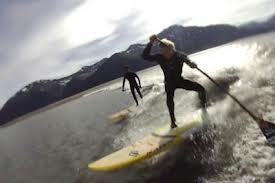
Robby Naish (happy birthday this week) and Kai Lenny in Alaska

Robby Naish (happy birthday this week) and Kai Lenny in Alaska

Recently I watched a short video of Kai Lenny and Robby Naish paddling around icebergs and basically “chilling” in Alaska. It’s good to study their stance, paddle placement, reach, posture and recovery during racing sequences as well as more recreational paddling.  Sometimes it’s tough to assimilate exactly what is making their performance so efficient and powerful.

dave-safebackThis very short video by Dave Kalama posted on the Distressed Mullet YouTube channel gives direct and easy to implement advice on how to protect your lower back. Hinging rather than bending is a habit that is not too difficult to hone – give the video a few, or maybe a couple of views then try the movement on your next paddle.

Dave Kalama provides a more advice in his blog article I found to be easy to put into practice. “Don’t rush.”

He explains that even if your technique is effective, it doesn’t necessarily mean that you are utilizing it properly. If you rush through all the phases of your stroke and don’t take the time to execute each phase correctly, then you are not using your level of technique in an efficient way.

For me, one of the pieces I took away was to take the time to really drive the paddle down into the water. Create a complete stretch of your reach. According to Dave, ” it only costs you a little patience and time to completely extend your arm forward. Also, rushing through the recovery phase will break the flow of a smooth rhythm, which is where real efficiency resides. If you rush into getting your hips all the way back under you to the neutral position, then you miss out on all the potential momentum you can generate through the hips. dave-technique

During yesterday’s training that resulted in muscle fatigue and “good workout” soreness, it might have been that fully extended reach, getting my hips back to neutral and rotating the upper body appropriately that made all the difference.  There’s nothing like practice, exploration and observation to add even more fun to this sport we love so much!

We’d love to hear from you – what blogs, videos or images have been useful as you improve your technique?


SUP Addiction: The Glide

Innocently, you join friends and fellow competitors for your first down wind SUP adventure. River, lake or open ocean – when the wind and the bumps cooperate the experience is incredible.

There’s so much to think about – paddle stroke, wind and wave direction, safety around rocks, channels, tankers or current and your own stamina and ability.  Whether your first run was 3 miles and easy or a kick-your-butt challenge, it’s likely you emerged from the adventure a different person.  Perhaps, like so many of us, all you can think about is doing it AGAIN! Yup, you’re hooked.

In between opportunities to do down winders, SUP Magazine has an online series that can provide tips and insights any time.  Take a look at the Glide Guide.

Some take-away tips from the video (see below) of Jeremy Riggs training Justin Gordon include:

The key thing keeping up your momentum.  Shorter rapid paddle strokes keep momentum going – keep speed up

Don’t go right up the back of the wave in front of you – that will slow you down and you paddle UP.

Look for the place to keep the momentum going, a place to guide the board into the trough where you can catch the next bump – and have tons more FUN!

GoPro: Wordsmithing Images

Each week I look forward to receiving links to GoPro VIDEO OF THE DAY.  Astounding views, amazing athletes, adventures and non-stop-action abound! Always diverse and endlessly cool – naturally when my friends and I watch these we hope to create something of that caliber ourselves.  We are passionate about standup paddling of every sort and we’re crazy about getting in and on the water at every opportunity.

Full moon magic is an Elder SUP routine, how about you?

Full moon magic is an Elder SUP routine, how about you?

Take the Water – Wherever You Are: Talking story around the fire on the beach, at a lakeside campsite or over a brew in a river town used to be the default way to re-live great SUP experiences. Armed with a GoPro easily strapped to a chest mount, a head mount, or a solid mount on our board we seamlessly collect images as we play our way through the day – or full moon night.  There’s no end to the number of ways we can “take the water wherever we are” via cool video clips and movies – Dropbox, Vimeo, Picasa, YouTube, Facebook, blogs.

The next question begs, “How many of your videos are so compelling that friends – and friends of friends – actually want to watch your story?”  For me, as long as there is beautiful water, people grinning and having a good time and a play of light and sights – then I am into a video. Next caveat, attention span.

We love a production called, Reflections, but at 8 minutes it’s asking for a lot from most of us. As a poetic approach to editing wonderful video footage, it’s inspiring.

Where's your inspiration-generating water?

Where’s your inspiration-generating water? Here is Suzie Cooney of SuzieTrainsMaui.com getting her stoke on!

So here’s our plan. During an upcoming vacation to Maui, rather than trying to get epic shots of us catching waves (not so much) or attempting to capture the energy and magic of the Olukai Ho’olaule’a while actually participating, we will simply capture what we capture. We’ll plan some shots that would set a mood or emotion.  Later, all sun-burnt, salty and inspired, we’ll create the wordsmith story, maybe even a poem, that comes to mind. With that as a guide, we can watch our GoPro footage again and again. Grabbing scenes and images that can be woven into a story may be commonplace for many videographers. For us, it’s going to be new – an adventure of its own.

For a terrific example of great word-smithing of images can be, check out Blue Sway by Paul McCartney, below.

SUP Surf: Yin andYang

groove_yoga_teachers_3_2373079703

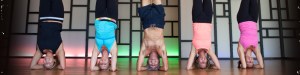
The instructor team at Groove Yoga Bend

The high desert town of Bend Oregon is blessed with a mighty volcanic peak, Mt Bachelor. Surprisingly Bend also hosts a strong surfing and ocean-loving community. In an excerpt from the SRF Mission statement, Bend local, Gerry Lopez, explains, “Even though the sea is Yin and the mountains Yang, a person can seek and find a balance of harmony while enjoying both worlds.” We are glad to enjoy that balanced life with him.  Last Friday evening several dozen lucky yogis met at Groove Yoga Bend for a 90 minute yin yoga class with Gerry.  Every teacher at Groove is uniquely gifted, but there’s no doubt that Gerry’s life experience and commitment to his practice provide a treasured experience. As Gerry encouraged us to allow the postures move into our bodies, rather than pushing our bodies into postures, we had plenty to focus on as we held poses for … a very long time!

Gerry encouraged our focus on breath and allowing thoughts to simply pass through. As we moved toward the balance yin yoga can provide, Gerry’s calm narrative taught us much about the yin and yang of yoga, life and – even surfing. During one segment of pigeon, my wandering mind overcame every attempt at focusing on breathing. I tried to imagine the calm yin one could experience while surfing even while a wave might be a swirling of yang surrounding.

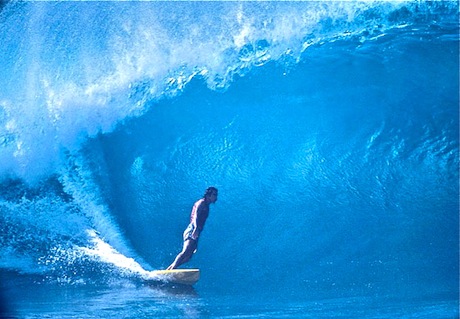
Photo by Jeff Devine

Photo by Jeff Devine

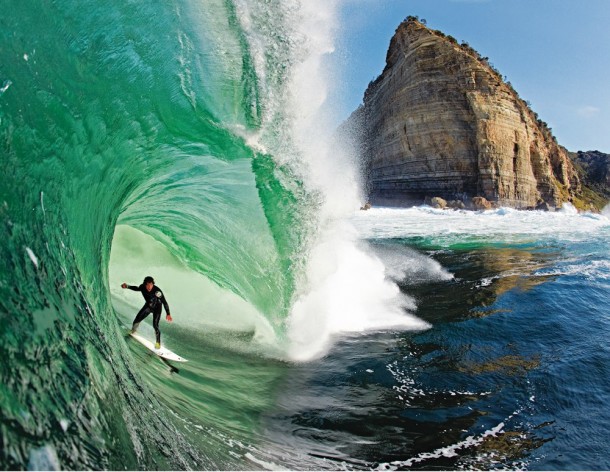
The iconic images we’ve seen of Gerry’s elegant and super-cool style on a wave flashed through my mind.  Within the yang power and seeming chaos of a wave, Gerry is a dot of calm yin a midst it all.   Folded in pigeon pose, my wave images flashed back to wonderful surfing trips at Oregon’s Pacific City. “Breathe, be the yin within the ride,” I said to myself. A few images sprang to mind. At first it was that fear-panic that arose trying to paddle out in short interval, fast moving whitewater. Slowly images morphed into those blue-sky-sunny-glassy day rides that soothe the soul.

Am I a dot of yin among that whirling yang?

Am I a dot of yin among that whirling yang?

Over time in that pigeon I could feel my breath flow into my skiing-punished knee and a tight hip. Breathe in, allow the breath to flow where tightness resides, breathe out and allow relaxation and lengthening. The long time in the posture was like a long time underwater after a washing machine wipeout. Fighting it doesn’t help at all. Allowing a yin sense of calm and focus to drive thoughts and action/inaction opens the door to what we seek – AIR! BALANCE! CALM!

When it comes to standup surfing – or any surfing for that matter – I am pretty much a novice.  But like you, there is a compelling call of water – liquid or frozen, salty or fresh – that we simply can’t ignore.  Like life, we might look at a situation, or sets of waves pounding in at fast-paced intervals and believe, “there’s no way!”

Study and breath - patterns are there

Study and breath – patterns are there

Just like agitation or fear can creep in during a yoga posture, we react similarly in life.  Maybe the next time life – or the surf – throws a scary set your way you can do what you do on the mat.  Allow your breath to calm you. Take time to see where fear or resistance resides. Find a way to discover patterns and order amid the chaos.

We’ve been inspired by Lopez over the years through both surfing and yoga. He explains, “Surfing has a lot of answers to most of the questions in life. Surf is where you find it.”
You might want to find Gerry at one of the many clinics and retreats that host his classes. A great opportunity is provided by Dennis Oliphant and Sun Country Tours


Take a moment to enjoy the video:

Safe SUP: Shoulders and Paddles

I have loved and used this KIALOA Paddles for almost 6 years. Exactly right for me!

I have loved and used this KIALOA Paddles for almost 6 years. Exactly right for me!

I have been using the same (now probably vintage) KIALOA paddle for almost 6 years. It has taken me across ocean, surf, downwind, upwind, flatwater and even ice.  It’s always going to stay with me, but today I picked up my incredible, technology rich KIALOA Hulu Ultralight GL  (Read a bit of the story behind the Hulu paddle here).

All the designs on the KIALOA Hulu paddles are cool.  I selected the GL Ultralight with the traditional Gerry Lopez design.

All the designs on the KIALOA Hulu paddles are cool. I selected the GL Ultralight with the traditional Gerry Lopez design.

Anytime you get a new piece of sports equipment: ski boots, skis, a road bike, running shoes – or a paddle, the decision on size, style and fit is always tough. Add to that the age of shoulder and knee joints, back and neck muscles and suddenly the decisions is full of variables, choices and options. What’s cool is that you can connect with the pros at KIALOA via Facebook messages and questions, by going to their blog with comments and questions, or chat with any of their ‘Elele (ambassadors) when you meet them at events. I have found each to be open and eager to share tips and insights. How do you find them at events? Mostly check out the podium or the KIALOA tent.

When I was making the all-important decision about paddle length I watched a lot of videos, talked to a lot of people, and then I did the smartest thing ever.  I borrowed the KIALOA Pupu adjustable paddle for an afternoon on the river. Donning my heart rate monitor and Nike+ as my speed/GPS tool I set off with my old paddle and the Pupu on board.  I paddled for about 20 minutes with my paddle noting speed and heart rate, paddle cadence and perceived effort. I tried to focus on how my shoulders, hips, knees and back were feeling. I went upstream then downstream.

Next I repeated the exact course with the Pupu adjusted to about 1 inch longer than my paddle. I repeated with it 1/2 inch longer, then 1/2 inch shorter. Those sessions were about 10 minutes each. I finished with a 5 minute upstream and 5 minute downstream paddle with my existing paddle.  The resulting decision – I kept my paddle length for my new Hulu at exactly what my old paddle had been. The experience taught me a lot about reach, grab, paddle stroke and upper body technique.

Raising the paddle, level and above my head, with my elbows bent at 90 degrees and equally spaced, I found that my lower hand seemed  too far down toward the blade. I was most comfortable paddling with my lower hand approximately one hand span back up toward the grip.  It’s important to get this hand placement right for you.

The further up your lower hand, the longer the lever arm; distance between lower hand and the center of effort of the blade. Positioning your lower hand too far up the shaft, creates greater reliance on using leverage (pushing forwards with the top arm) as the primary means in generating force to the blade. It’s been a long time since I studied physics or levers, but that basic principle make good common sense.  Using the paddle as a long lever is a very poor use of bio mechanics – and will not make shoulders very happy.

I had a conversation with Karen Wrenn after a longer training paddle sent me home with sore knees.  In a nutshell, she advised me to find a balance in using power generated through pulling from the throat of the shaft (lower hand) and being aware of the rotation (torque) around the my spine and compression downward  through the top arm. Keeping my hips forward and rotating through my upper body (feeling next soreness in lats and upper back) was the recipe for very happy knees.

The bottom line – take your time on the water as you decide upon the right paddle for you. Whether you surf, race, cruise flat-water or meander around in lakes, investing an hour or so with an adjustable paddle can make all the difference for your long term SUP fun!


Aloha of the Paddle

Our SUP paddle – connecting us to our water, our power, our speed and the aloha of our our sport. Choose wisely and understand small tweaks in sizing and technique that make all the difference.  Part of the “aloha of the paddle” is the great community of people willing to share info and insights about all aspects that impact both performance and enjoyment!

A conversation with Randall Barna, SUP pioneer and owner of FootForm Performance Orthotics Center in Bend Oregon, always leads to great technique insights. During a recent paddle I was absently day-dreaming about my soon-to-be delivered Hulu KIALOA paddle while listening to the steady rippling of wind current under my board.  I wasn’t really thinking of my technique, just sensing the paddle position through the reach and recovery and watching out for river otters. Randall commented, “You might want to try something a little differently as you switch your paddle from side to side.”

I am always up for more power or speed, especially if it’s driven by efficiency. Randall showed me a seamless way to switch my paddle from side to side. Removing the upper hand as the lower hand remains steady on the paddle during the crossover (maybe inching it up the shaft an inch or so) allows the “new” bottom hand to grab at just the right spot allowing an immediate “reach and dig” as the new upper hand slides up to the grip. It was a simple change but really added a solid confidence to switching paddle sides.

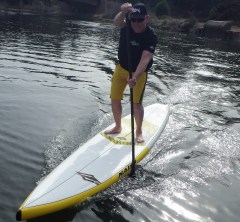
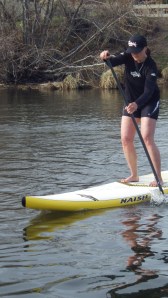
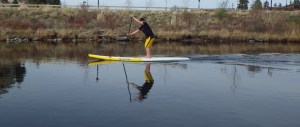
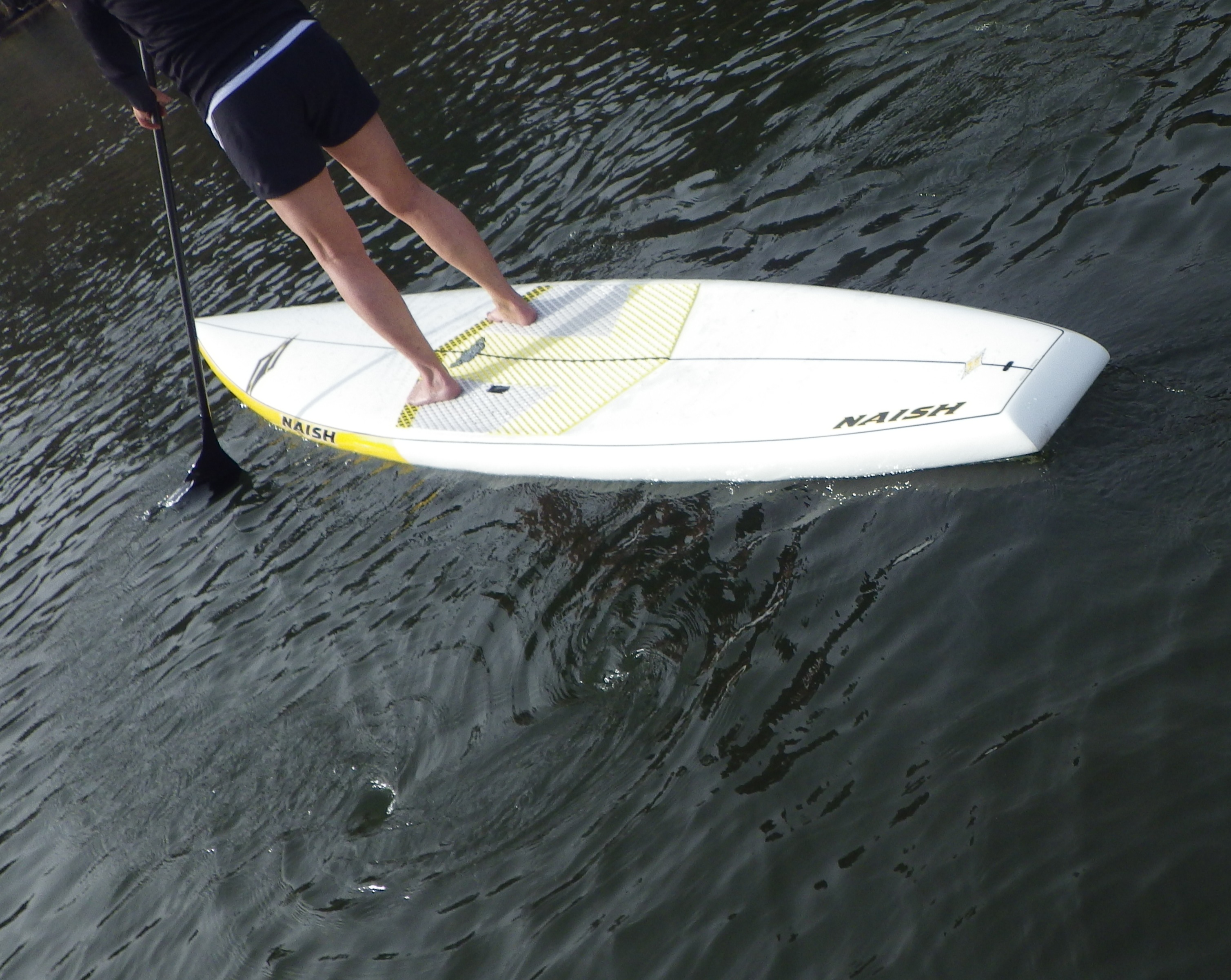
Board speed and chop, two foot placement variables

Board speed and chop, two foot placement variables

As long as Randall was sharing insights gained by a lifetime of wind and water sports I invited him to share tips on foot placement. “The key to foot placement is adapting and adjusting to all the variables. As soon as you think you’ve nailed your stance something changes! The two main variables are board speed and chop. The two errors are tail drag and pushing the nose.

You’re too far back on the board and tail drag is a drag. It slows you down more than anything else! Too far forward and you’re pushing water instead of gliding. The key is a balance between the two.”
Variables in board speed require you to make constant, minor adjustments. Take some pictures of yourself on your board while pictures standing still. Is  the tail is out of the water? With a little speed the tail is right on the surface. That’s because under power the board starts sinking into the trough of it’s own bow wave. naishbow
Randall continued, “Progressing into higher speeds the bow wave gets bigger, the board lower, and eventually it hits “hull speed,” a point where it won’t go any faster no matter how hard you paddle.  Every board responds to this differently and is dependent on the weight of the paddler too. You just have to experiment with foot placement at hull speed, find your sweet spot, and mark your toe line on your board as an instant reference.”
Note: huge grin on Randall’s face as he shares this: “The big thrill in riding an SUP is planing! To achieve planing you have to get your bow through your bow wave, up and over it! Nobody has ever accomplished this by paddling. Longer boards are faster due to a longer interval between the bow wave and tail wave,but still no planing via paddle.  It takes a boost from an outside source like wind and waves. As soon a the boards cuts-loose onto a plane you have to adjust your foot position faster than poop-thorough-a-goose. The nose will dive, the tail was lifted by the wave, so step back. You need to constantly walk the board and paddle to keep it on a plane, and enjoy the ride.”
Champing at the bit to get on  Naish 14' Glides on Maui

Champing at the bit to get on Naish 14′ Glides on Maui

Experimenting on flat water is not easily transferred to choppy waters. The nose of the board becomes the focus.  If your nose is pushing, it will slap each chop and be very slow. Find a foot position where the nose will penetrate the chop without slapping or pushing. Side chop, and accompanying wind, can catch your nose and flip you over! Try a surfer-stance for more stability, with the wind at your back. You won’t be switching sides with side-winds anyway so this works. Another source of choppy water is when drafting another SUP. Then you’re dealing with their tail wake, your bow wake, and the chop all at once! All of this is a never ending challenge and one of the things that makes standup paddling so darn much fun!

SUP: Da Feet

That moment after a too-steep take-off when the nose of your surfboard buries deep, that moment just before you rocket through the air tightly clutching your paddle – you know! You know that your feet were not in the ideal position to trim your board successfully – it’s obvious.

Karen Wrenn posted this very cool photo - great color and an easy way to study foot position and technique.

Karen Wrenn posted this very cool photo – great color and an easy way to study foot position and technique.

More subtle are the changes in board trim and efficiency or glide that occur with where your feet are place and the balance of weight on those two feet when going in flat-water or downwind. A good example is the way Karen Wrenn is positioned in the photo to the left. She was kind enough to explain, “If you notice how my feet are really far on the left side of the board… it’s because there was a super strong side wind coming over my left shoulder. I had to position myself on the far left of the board to keep from getting pushed by the wind to the left. With my body weight on the left side of the board it allowed me to get my left rail down and prevent getting pushed and tipped.”

Knowing the force of winds in the gnarly Columbia Gorge area where Karen spends a great deal of training time, that is good to know. As the weather warms, our local SUP community plan many jaunts to the Hood River and Portland area for down wind fun.

With just a few weeks before the most challenging down wind adventure of our lives at Maliko Gulch and the Olukai Ho’olaule’a, we have been barefooting it on the sleek 14′ Naish Glide as winter hiccups into spring.  Balance as we maneuver is crucial – falling into the barely above freezing Deschutes River is not an option.

There’s the rub! Tail turn practice goes tentative – and immediately balance becomes sketchy.  It’s a great mental practice to feel the right movement to position and coordinate strong paddle strokes.

Evening light adding to our bliss!

Evening light adding to our bliss!

Our puzzle remains – what’s the best foot position for the various aspects of conditions we’ll encounter on the Maliko down wind route?  We will be sharing this post far and near, hoping for insights and input. While we will be participating in a “race,” our goal is safe completion of the journey.

Wondering how this foot position is for strong "wind in the face" situations

Wondering how this foot position is for strong “wind in the face” situations

Ed is experimenting with feet further back, noticing the impact of the tail drag vs speed and efficiency

Ed is experimenting with feet further back, noticing the impact of the tail drag vs speed and efficiency

We know we have awesome equipment with our Naish 14′ Glides underfoot, so we hope to refine our skills so that we can make the best of the famed “glides” we’ll be earning along the way.  How incredibly cool is it going to be to feel that first rush of wind after going beyond the cliff at Maliko Gulch! What a thrill it’s going to be to be surrounded by hundreds of other paddlers as the swells start rising on our quarter and from directly behind!

Butterflies – yup! We can’t wait to practice in the warm ocean – to fall as often as needed into WARM water – and to peddle forwards and back along the foot-friendly deck of the Naish Glide.  The best and right equipment for the adventure adds so much confidence and fun to the mix! Yeah, the stoke is fueled.

Please share your insights and comments on the blog or via e-mail eldersup@gmail.com – some comments we have received so far can be read at Aloha of the Paddle.

This seems to be a good foot position for flat water up wind and down - comments?

This seems to be a good foot position for flat water up wind and down – comments?

A Deeper Shade of Blue

In theaters across the country on March 28th legions of surfers, ocean-loving souls and fans of legendary Jack McCoy gathered for a one-night only showing of A DEEPER SHADE OF BLUE. Many familiar faces (and some very well-known) crowded together ready for a great show – and that’s exactly what was delivered.  Careful research and 5 years of story development with countless hours of editing film and music was evident in this excellent finished product.  No one can “talk story” about the soul of surfing better than the legends themselves.

Jack McCoy's DEEPER SHADE OF BLUE delivered way beyond expectation!

Jack McCoy’s DEEPER SHADE OF BLUE delivered way beyond expectation!

It was easy to become so fully immersed in the video images – the color, the energy and the waves – that some of the dialog slipped past my conscious hearing.  The soundtrack – want it!  Here is one example of the music by Paul McCartney  integrated perfectly with views most of us will never experience.


Danger in all shapes and forms at Ships Stern with Marty Paradisis

Danger in all shapes and forms at Ships Stern with Marty Paradisis

In an almost polar-opposite mood, an “Are you kidding me? Are they really riding that” segment showcased Marty Paradisis riding an insane monster of a wave with weird shapes and breaks found in the below freezing waters south of Tasmania. I was startled out of a mellow sense of soul and surfing and aloha by the juxtaposition of that gnarly – seemingly crazy – choice of wave. The audience gasped after the endless bone-crushing wipeouts delivered by that wave. Where was the soul connection we’d just shared with so many legends?

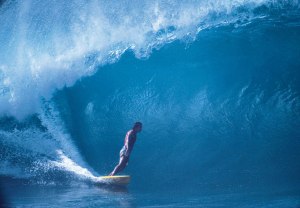
Earlier in the film, our local audience particularly enjoyed the segment about Pipeline narrated by the “Pipeline Master,” Gerry Lopez.  As the film moved past that narrative with story after story about Lopez’s ability to surf Pipe, a wave at the time was deemed “unsurfable” by the generation that came before him, some familiar connections emerged. Audiences heard how Lopez has studied yoga for over 40 years and, in his own words, “finding peace in your mind through yoga and true focus through surfing. “There are so many different factors coming together that you have to be completely focused to catch the right wave at the right time,” Lopez shared.

Banzai Pipeline, 1979. Photo: Jeff Divine

Banzai Pipeline, 1979. Photo: Jeff Divine

The right wave at the right time: Now that is a powerful statement and could be the metaphor I needed to make sense of the calming spirit of aloha vs what seemed like a crazed death-wish in southern Tasmania. Each of us has a right wave at the right time – if we are open enough to see it, focus and connect with the soul of what we’re after. Perhaps the soul of Marty Paradisis has no choice but to ride the wave that is his right wave at the right time.

The final scenes of the film followed the rhythmic and very long small-wave Waikiki ride of a 5-year-old boy.  Connecting across generation and across oceans the story of surfing lives forward – with soul and aloha when at its best. We all have the choice to ride (and live) with the full meaning of “aloha” through our choices on and off the water.  (The scene in which a grandmother shared her breath, he “ha” with her grandchild was one of the most impressive in the film for me).  I didn’t always get that.

Packed with 44 stories and wisdom, wit and insights - grab a copy or re-read yours!

Packed with 44 stories and wisdom, wit and insights – grab a copy or re-read yours!

Here in Bend, Oregon we have the opportunity to share some water time and some yoga time with the humble, cool and focused legend, Gerry Lopez himself.  Occasionally he’ll lead a class locally in addition to  many other destinations worldwide.  Those 60-90 minutes really inspire my “newbie” dedication to following a yoga practice – particularly around breathing.  In a recent interview with SurferMag online, Gerry explains, “The learning curve is so steep in surfing that if you’re not fully tuned in to your surroundings and completely focused on what’s happening around you in the lineup, you’re going to fail. Learning how to breathe properly is really important. It’ll calm you down when you’re stressed, relax your body, and tighten your focus. These are all things you want to be doing when you’re surfing. ”

Surfing and life, surfing for life – breathe.  Thanks for an amazing film, Jack McCoy!

SUP: The Wave and You

Have you read Susan Casey’s book, The Wave? (Seriously awesome video based on the book)

Casey, 44, editor of magazine, traveled the world experiencing waves close up and personal. Casey, who wrote The Devil’s Teeth, a 2005 best seller about white sharks, didn’t want to write a book just about surfing. She was driven to write about waves, some almost mythical in stature.  To do this, Casey needed a guide to “open up his world to me” and provide a “glimpse of the ocean with its gloves off.” One of her guides to waves, like Jaws on the North shore of Maui, was the waterman, Laird Hamilton.  Her encounters with the famous Jaws were described so vividly, it felt as though I was there as I read.  Even accompanied by big wave surfer, Laird Hamilton, (another cool video) would I charge the face of Jaws in a jet ski or dive below and witness the sea-floor configuration that causes that incredible wave? I certainly hope so!

Auhtor of THE WAVE, Susan Casey, with her guide to Jaws (Maui), Laird Hamilton.

Author of THE WAVE, Susan Casey, with her guide to Jaws (Maui), Laird Hamilton.

Casey told Hamilton about a freak North Sea storm in 2000 that battered and nearly sank a research ship — the opening scene in her book.

“He wished he had been there,” she recalls.

 Hamilton explained, “What’s hell for some is heaven for others. A storm like that  can stir up “the ultimate playground” for big-wave surfers.

Have you ever been schooled by a wave just a degree or two (or 3) above your skill level? One that held you down, knocked the tar out of you and was fodder for stories for weeks after? For some, that wave is calf high, for others a triple overhead at Pipeline.  I found my limit one cold October morning doing dawn patrol with my husband, Ed, and our buddy Randall.

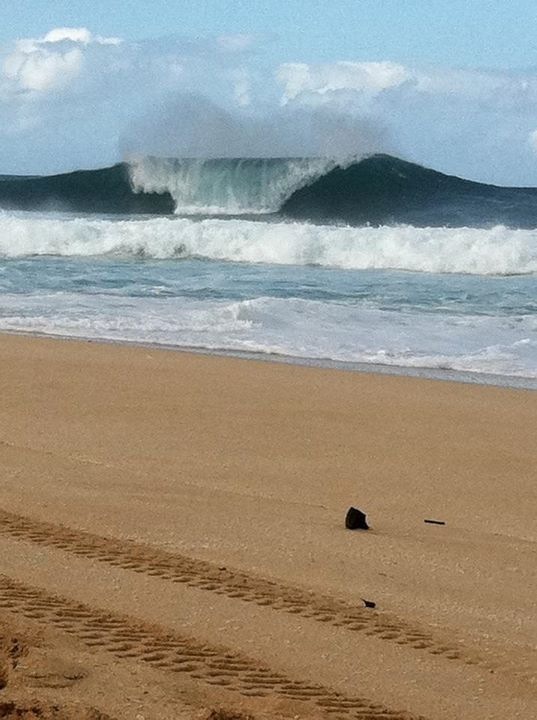
Pipeline - December 2011

Pipeline – December 2011

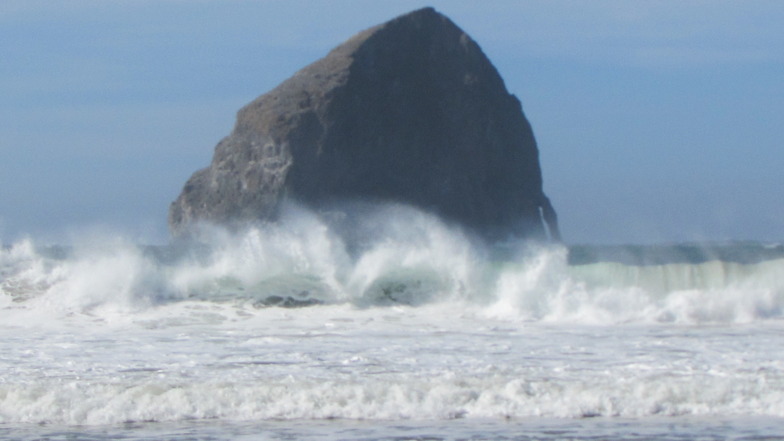
After a 40 year hiatus from surfing it was the third fall I’d been SUP surfing, 2011. We’d only planned to sit on the beach at Pacific City (Oregon) with a coffee. Out in the light fog about 1/2 mile offshore a set of big fat and beautiful glassy waves wrapped around the point at Cape Kiwanda and solidly marched through the deep water. Rather than crashing or closing out, they simply diminished before re-building on the more shallow reef onshore. A setup that rare had to be experienced. Wetsuits donned we paddled out.

Holy cow – heart in throat time…what was lurking under the glassy beds of seaweed out by the rock? Would I have the nerve to really go for a wave that seemed to swallow up Ed and Randall as they disappeared behind the overhead walls they took?  The third swell of a set loomed up. I was bit further in than the “safe” zone – having sort of tried for the first wave.  That made the wall and takeoff a bit more steep – but something made me dig for it an GO!

My skills are very limited and bottom turns – not so much.  Yet something clicked on that wave, I dug my KIALOA paddle hard into the face and powered a nice right that lofted me up the face at a speed that  I’d never felt before. The board vibrated under my feet with a shattering sound that serenaded with whistling wind, and filled my ears. “Wooooohooooooo!” Yeah! There was nothing but an amazing rush. In a few seconds when time stood still that was a ride to remember. Then the shoulder flattened out in a deep water channel close to shore and I cruised over the top and paddled back out. I caught two more waves before reaching the edge of my “courage”envelope. I went in way before anyone else – but it was enough.

Brit Oliphant using her skills to backdoor a section on her backhand, Sweet use of her KIALOA GL ULtralight HULU paddle

Brit Oliphant using her skills to backdoor a section on her backhand, Sweet use of her KIALOA GL ULtralight HULU paddle

Totally amazing and I haven’t ridden anything like that since.  Yet, it is cool to have some experience so that when I see someone tackling a nice sized waveI I can  have a small sense of what’s so incredible. The photo to the left shows Brit Oliphant, a Surftech team rider, ready to dig her KIALOA Hulu GL Ultralight paddle to backdoor a section on her backhand.

Imagine the sounds and feel of the speed and wave power as Brit maneuvers across that overhead face.  Surfers everywhere and at every ability level share a common set of awe and experience for the waves they’ve ridden and waves they been thrashed by. The most important thing about the ocean is that we explore it. It’s our source and where we’ve evolved from — it’s spectacularly beautiful, and it’s really, really powerful. Whether we ride the big ones or live extreme moments vicariously, we share a common energy.

Respect your skill and respect your ocean – love your moments and your abilities on your waves. A very wise surfer, one whose spirit of aloha graces all he does, is Gerry Lopez. In his book, SURF IS WHERE YOU FIND IT, he shares five rules. The fifth and final Lopez rule, “The best surfer in the water is the guy having the most fun.” Like Gerry, we can all try to remember that one.

A great shot of Gerry Lopez originally posted in 1859 - Oregon's Magazine.

A great shot of Gerry Lopez originally posted in 1859 – Oregon’s Magazine.

Okay, grab your paddle and your board – have some fun and dream of waves! Then share your stories with us – via e-mail or on Facebook.